
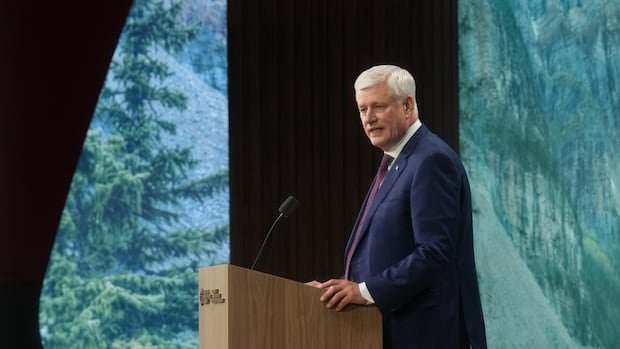

Former Canadian Prime Minister Stephen Harper, who led the Conservative Party for more than ten years, expressed support for the Canadian government’s decision to discontinue trade negotiations with the United States, leading to the initiation of a trade conflict. Harper made these remarks during his closing address at the Canada Investment Summit in downtown Toronto, where he spoke to a large audience of global investors.
Acknowledging the complexity of the decision, Harper stated that he believed the government had no alternative but to pursue this course of action. Despite his personal affinity for the United States, Harper emphasized the importance of Canada maintaining its economic diversity and preventing the erosion of its industrial capabilities by the Trump administration.
Harper highlighted the necessity for Canada to decrease its reliance on the United States to safeguard its sovereignty, as the current U.S. administration perceives economic integration with Canada as a threat to sovereignty. He expressed both sadness and the inevitability of this situation.
Regarding Canada’s shift away from its traditional ties with the U.S., Harper described it as an opportunity for the country to rediscover its true potential. He emphasized the significance of leadership in taking responsibility for controllable factors, urging Canada to enhance its competitiveness, international connections, and sovereignty.
The Canada Investment Summit, organized by Prime Minister Mark Carney, concluded with Harper’s closing remarks. The summit aimed to attract substantial investments over the next five years to support major projects throughout Canada.
As the Chair of the Alberta Investment Management Corporation (AIMCo), a position he has held since 2024, Harper emphasized the importance of Canada’s resource development as a competitive advantage, emphasizing the need for the country to become an energy superpower for its prosperity and survival.
Reflecting on missed opportunities, Harper criticized the policy choices made by subsequent governments that hindered Canada’s potential to become an energy superpower. However, he praised the current government’s efforts to expedite project approvals, particularly in Alberta’s oilsands, and commended the investment summit as an innovative initiative.
Harper urged the government to eliminate unnecessary barriers and reform regulatory processes to provide investors with certainty and enable Canada to compete effectively. He warned that without such reforms, the U.S. would remain Canada’s primary customer, emphasizing the importance of government action in these areas.
Despite past disagreements with Carney, Harper’s endorsement of the summit and the government’s direction signify a change in his stance. He previously criticized Carney’s role during the financial crisis but has since lauded the government’s initiatives and expressed optimism about future reforms.
In conclusion, Harper’s address at the Canada Investment Summit underscored the importance of unity, reduced dependence on the U.S., and proactive measures to enhance Canada’s economic prospects.