
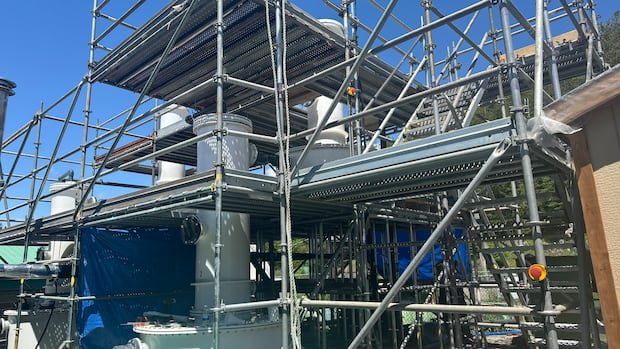

A startup in Nova Scotia is experimenting with a technique to capture and store more carbon in the ocean, utilizing a new pilot facility to validate the concept.
The ocean already serves as a significant reservoir for excess carbon dioxide, having absorbed roughly 30 percent of all human-induced carbon emissions since the 1980s.
pHathom, the company behind this initiative, aims to further reduce emissions from the atmosphere by capturing carbon dioxide and converting it into a form that can be securely stored in the ocean for thousands of years.
The company will conduct testing at the Huntsman Marine Science Centre in St. Andrews, N.B., to demonstrate the safety and effectiveness of their approach.
Kimberly Gilbert, the co-founder and CEO, emphasized the importance of proving the safety and efficacy of the local solution to address the global issue of climate change.
pHathom’s method mimics a natural process where raindrops absorb carbon dioxide from the atmosphere, becoming slightly acidic. When these raindrops interact with alkaline rocks like limestone, the carbon dioxide is converted into bicarbonate, which can be stored in the ocean for extended periods.
By exposing seawater to the emissions from a biomass power plant in a reactor, the company’s method efficiently converts carbon dioxide into bicarbonate using limestone particles, ensuring the treated water can be reintroduced into the ocean with minimal environmental impact.
Several companies in Nova Scotia are exploring variations of this carbon removal approach known as alkalinity enhancement, including Planetary and CarbonRun.
The pilot phase of pHathom’s project aims to capture 0.1 tonnes of carbon dioxide daily, with plans to scale up operations in Nova Scotia next year if successful.
While the potential of ocean alkalinity enhancement as a climate mitigation technology is promising, challenges related to scale, energy consumption, and regulatory frameworks remain significant.
Despite these hurdles, experts emphasize the importance of exploring and investing in carbon removal technologies alongside efforts to reduce emissions from fossil fuels.
Recent developments in Canadian climate policies have introduced uncertainties in the market for carbon capture and storage projects, but industry leaders like Kimberly Gilbert remain hopeful that economic and environmental imperatives will drive global action towards sustainable solutions.