
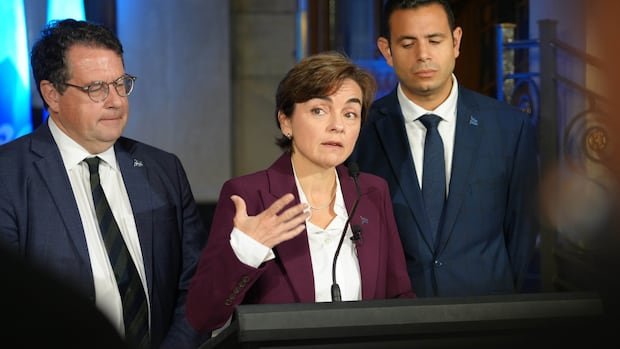

Christine Fréchette, the leader of the Coalition Avenir Québec, is facing criticism from political rivals for halting her election campaign to convene her cabinet amidst the ongoing trade dispute with the United States. In a recent meeting, Fréchette, acting as the premier, discussed Quebec’s response to Canada’s retaliatory tariffs and unveiled new initiatives to support businesses and the economy during escalating tensions.
Questions have been raised about whether a caretaker government leader overstepped boundaries. Political analyst Antonine Yaccarini highlighted that Fréchette leveraged recent major announcements with Prime Minister Mark Carney to establish herself as an economic figure and make tariffs a focal point of her campaign.
Fréchette’s opponents, except for Québec Solidaire, accused her of exploiting the trade conflict for electoral gain. Parti Québécois Leader Paul St-Pierre Plamondon criticized her tactics, labeling them as fear-mongering and diversionary. Similarly, Quebec Liberal Party Leader Charles Milliard pointed out the unprecedented nature of Fréchette’s cabinet meeting and new measures announcement in response to the tariffs.
Fréchette defended her actions, emphasizing the need to address real-life challenges and advocate for Quebecers’ interests, including language rights and supply management in trade negotiations with the U.S. Analysts like Yaccarini acknowledged that Fréchette faces a dilemma of being criticized whether she takes action or not amid the crisis.
As a caretaker government, Fréchette must exercise caution per the convention of avoiding major policy shifts that could bind the incoming administration. While her initiatives aimed at supporting local businesses garnered attention, critics from the PQ and Liberals expressed concerns about potential negative impacts and inadequacy of the measures.
With the election campaign intensifying, the debate over Fréchette’s handling of the trade war has become a central issue. The upcoming leaders’ debates could shape the narrative, with the first French-language debate scheduled for September 15 and voting day set for October 5.