
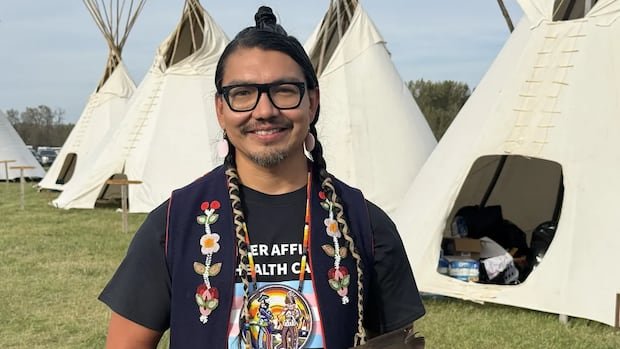

An Indigenous community in Alberta is planning to establish a sanctuary for gender-affirming medical services, defying the provincial government led by Premier Danielle Smith. The Saddle Lake Cree Nation asserts that healthcare access is a treaty-guaranteed right falling within its inherent jurisdiction.
Last year, Smith’s United Conservative Party government utilized the notwithstanding clause of the Charter to shield its laws from legal challenges. One such law prohibits doctors from prescribing puberty blockers or hormone therapy to transgender and gender diverse children under 16. While the premier argues it is to safeguard children and their fertility, medical professionals and national associations counter that puberty blockers do not cause infertility.
Chief Dale Steinhauer denounced the law as dehumanizing and declared a stand against the infringement of rights on Wednesday in Fort Pitt, Sask. The Nation, situated northeast of Edmonton, is actively seeking clinicians to offer care on its reserve lands. Fundraising efforts have begun to develop a health law to safeguard and uphold it against potential legal disputes.
Steinhauer emphasized that clinicians providing gender-affirming care on reserve lands would be exempt from regulatory sanctions. Dr. James Makokis, a two-spirit family physician from Saddle Lake Cree Nation, emotionally addressed the impact of violence against two-spirit and transgender individuals, including self-harm, labeling it a public health crisis that must cease.
Referring to Treaty 6’s medicine chest clause, Steinhauer highlighted a commitment to comprehensive health care that Indigenous leaders believe has not been fulfilled by the Crown. She questioned how the Alberta government could impede First Nations doctors from practicing or accessing the medicine chest, emphasizing the historical lessons unlearned by colonial administrations.
Alberta’s UCP government has introduced three laws affecting transgender individuals in the province, including the parental consent requirement for students under 16 to change their names or pronouns at school, and the ban on transgender athletes aged 12 and above from participating in female sports competitions. The government defended these laws as choices preserving children’s rights, strengthening parental roles, and ensuring fairness and safety in amateur sports.
A spokesperson for Justice Minister Mickey Amery reiterated the government’s commitment to these principles, emphasizing the unapologetic stance of Alberta’s United Conservative government.