
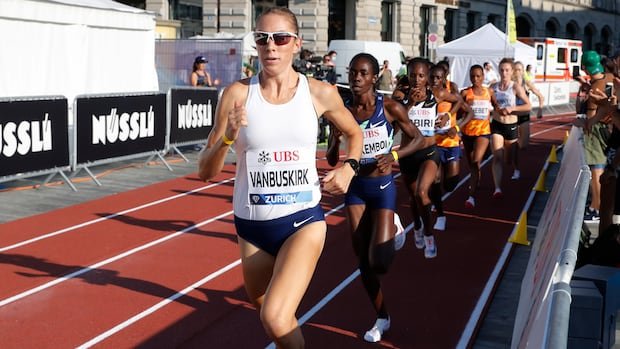

Canadian runner Kate Van Buskirk achieved her second fastest time in the women’s 5,000 meters during her Olympic debut at the Tokyo 2021 Games, which took place in scorching 41-degree Celsius weather. Following the race, Van Buskirk collapsed on the track, reflecting on the moment as one of the most “egregious” instances she was captured on camera, with images showing her “sprawled out” from intrusive angles. Despite some photos being inappropriate, she emphasized the importance of focusing on athletic performance over appearance in women’s sports.
A report by The Representation Project revealed that female athletes at the Tokyo 2021 Olympics were sexualized nearly 10 times more than their male counterparts. This disparity occurred despite broadcasters being advised to prioritize sport appeal over sex appeal when filming the competition. Van Buskirk, who has retired from athletics and now works as a media analyst, highlighted the need for careful positioning of photographers to avoid emphasizing only one angle during coverage.
The discussion around women’s sports uniforms and their impact on media coverage has been ongoing, exemplified by the controversy surrounding Nike’s revealing Team USA track and field kit for women ahead of the Paris 2024 Olympics. Van Buskirk emphasized the importance of feeling comfortable and dignified in her uniform, opting for minimalist “bunners” to balance performance and respect as an athlete.
In an effort to address problematic broadcasting habits, the European Broadcasting Union and European Athletics introduced new guidelines in July 2026 to enhance coverage of women’s athletics. These guidelines aim to discourage close-ups on specific body parts, low-angle camera placements, and excessive slow-motion replays without narrative value. The focus is on respecting athletes’ privacy and dignity, as inappropriate camera angles can lead to online abuse and objectification.
The importance of respectful coverage in sports extends to the World Athletics Organization’s introduction of miniature cameras in starting blocks during the 2019 world championships in Doha. While the cameras were intended to provide innovative angles, some athletes, including Gina Lückenkemper and Tatjana Pinto, raised concerns about privacy and discomfort with the camera placement. Following feedback, measures were implemented to protect athlete privacy and ensure editorial guidelines were followed.
As the spotlight remains on athletics leading up to the World Athletics Ultimate Championship in Budapest and the LA 2028 Olympics, the need for informative and educational broadcasting without veering into objectification is paramount. Van Buskirk emphasized the distinction between storytelling and objectification in sports coverage, urging for a focus on athletic excellence and respect for athletes across all genders.