
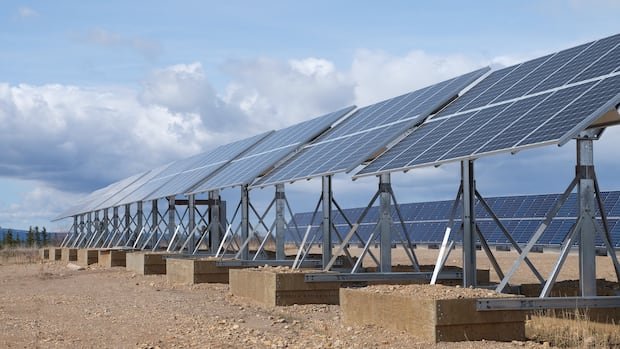

The government of the Northwest Territories is encouraging power companies to boost their utilization of renewable energy sources. However, some experts believe that current constraints, such as costs and aging infrastructure, could hinder the immediate implementation of extensive renewable energy initiatives.
In response to directives from the government, the territory’s Public Utilities Board was instructed last year to facilitate the expansion of renewable energy by allowing independent producers, like community energy projects and individual homeowners, to inject more renewable power into the local grid. Presently, the cap on renewable power input for each community stands at 20% of the annual average load demand, with plans to raise it to 30%.
Several communities have already reached the existing cap, prompting the government to push for an increase to accommodate more renewable energy projects. The two primary power companies in the N.W.T., Naka Power and the N.W.T. Power Corporation (NTPC), have acknowledged this proposal and expressed willingness to work towards enabling the increase, albeit with specified limits and definitions. They emphasized that exceeding the 30% threshold would necessitate additional mitigations due to the impact on the efficiency and reliability of diesel generators caused by the variability of renewable energy sources.
An engineering study commissioned by the territory in 2021 assessed the maximum threshold of renewable energy generation that the N.W.T.’s electricity systems could sustainably manage, determining it to be 45%. Beyond this point, additional infrastructure like battery storage systems and microgrid controllers would be required.
Renewable energy production, particularly from sources like solar, is subject to fluctuations based on weather conditions, time of day, and seasonality, making the amount of electricity entering the system unpredictable. The limitations set by utilities are based on their ability to manage the integration of renewables effectively.
Notably, the integration of battery and solar projects in communities, such as Colville Lake and Inuvik, has demonstrated the potential of hybrid energy systems supported by federal funding. However, there are financial implications for utility companies due to reduced power sales when customers generate their own electricity. The consultant’s report estimated a net revenue loss for utilities from independent renewable generation, projecting potential losses of up to $2.7 million within a decade if the current capacity limits are upheld.
Recognizing the importance of storage in supporting renewable energy, Dennis Bevington advocates for the adoption of batteries to stabilize the energy system and enhance reliability. While batteries are seen as a crucial component in modernizing northern grids, they come with associated costs that need to be considered against the backdrop of existing electricity system expenditures.
The ongoing Public Utilities Board proceeding, expected to continue into 2027, will provide stakeholders and intervenors with the opportunity to submit feedback on proposed changes next March, leading up to a public hearing in June.
Image source: [Link to image source]
[Source](https://www.cbc.ca/news/canada/north/nwt-power-companies-renewable-energy-9.7330380)