
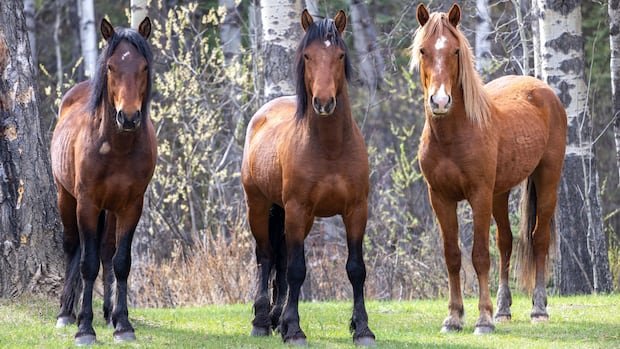

Health Canada has granted approval for a birth control vaccine to be tested on free-roaming horses in Alberta, as confirmed by a Health Canada spokesperson to CBC News. The Alberta government deems horse population control necessary to prevent excessive grazing pressure on cattle and wildlife areas in certain regions of the province where horse numbers have surged to concerning levels.
Contraception is among the strategies outlined in Alberta’s feral horse management framework, which also includes wild horse removal and adoption. The recent “research authorization” received by the Alberta government allows for the study of the contraception vaccine SpayVac-Equid on feral horses, emphasizing that this approval is specific to research purposes and not for general use.
The province’s latest feral horse survey identified 2,072 wild horses in Alberta’s equine management zones, marking the highest count to date. Of particular concern are the population levels in the Sundre, Ghost River, Elbow, and Clearwater zones, which are deemed unsustainable ecologically. The Alberta government classifies these horses as stray animals rather than wildlife.
In a bid to address the wild horse population issue, the province collaborated with the Wild Horses of Alberta Society on a contraception pilot project in 2014. The project involved administering a vaccine named ZonaStat-H via darts to wild horses. However, challenges such as high costs, rugged terrains hindering monitoring and booster shots administration, and the need for a significant portion of the female horse population to be vaccinated for noticeable reduction were observed.
The current strategy entails capturing horses, administering the SpayVac-Equid vaccine manually, and releasing the horses back into the wild, with vaccinated horses being visibly marked. This method, according to Wild Horses of Alberta Society president Jack Nichol, boasts an 85 to 95 percent success rate, prevents conception for three to four years, and does not disrupt herd dynamics. Unlike the previous contraceptive used, SpayVac-Equid does not necessitate booster shots.
The upcoming contraception project this fall will also involve capturing a limited number of young stallions for removal from the wild. The Wild Horses of Alberta Society, established in 2002, focuses on rescuing, rehabilitating, and facilitating the adoption of horses that stray onto private properties, with over 200 horses taken in since its inception.