
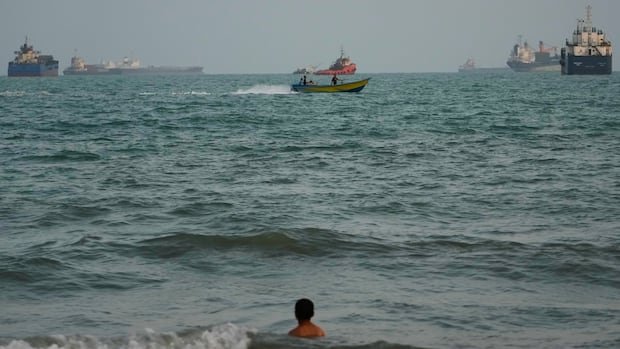

Iran’s new head of the Supreme National Security Council unveiled plans on Sunday to establish an “exclusion zone” outside the Strait of Hormuz to deter vessels it suspects are trying to pass through the waterway. Mohsen Rezaei made this announcement during an interview with Iran’s state broadcaster, lacking specific details. This development followed the U.S.’s targeting of three Iranian oil tankers in response to Tehran’s ballistic missile strikes on U.S. warships, which experts deemed a risky escalation following prior attacks on commercial shipping.
The proposed zone, set to be declared in the coming days and weeks, will stretch from the U.S. naval blockade line, extend towards the Strait of Hormuz, and further into the Persian Gulf. Rezaei stated that any ship identified in this area with the intent to traverse the Strait of Hormuz will face sanctions.
The exact delineation of the U.S. blockade remains unclear to Iran, aimed at Iranian ports to impede Tehran’s oil shipments. The U.S. military confirmed the support of over 20 warships for the blockade, redirecting 92 commercial vessels and disabling three as of Sunday.
In response to failed negotiations and ongoing hostilities, the U.S. has implemented additional measures to increase economic pressure on Iran. Concurrently, Iran continues to target ships attempting to navigate the strait, leveraging it as a strategic point in the prolonged conflict with the U.S.
Iran asserted on Sunday that it struck an unmanned U.S. vessel seeking entry into the Strait of Hormuz, a claim refuted by the U.S. military as baseless. This incident unfolded amidst renewed confrontations between the two nations following a period of relative calm, with the strait and Iranian territories along it facing attacks.
The U.S. administration has adopted a dual strategy, responding militarily to strait-related incidents while targeting foreign financial institutions handling Iran’s finances. Despite mounting economic pressures, Iran’s new leadership remains steadfast, indicating a readiness to endure prolonged sanctions.
Iran has historically evaded sanctions and the current U.S. blockade to export oil through alternative means, including a shadow fleet. The nation’s nuclear program, a central issue in the conflict, was slated for discussion in failed negotiations post the mid-June agreement between the U.S. and Iran.
Amidst deteriorating relations, Canada’s Foreign Affairs Minister condemned Iran’s destabilizing actions, emphasizing the maintenance of international pressure on Tehran. The Strait of Hormuz, pivotal for global energy trade, has become a focal point in the conflict, with the U.S. affirming the passage of approximately nine million barrels of oil daily through the strait.
U.S. Energy Secretary Chris Wright noted that current oil flows through the strait exceed pre-conflict levels, attributing this to U.S. naval presence ensuring safe passage. Rezaei claimed Iran continues to sell oil daily, portraying a semblance of routine despite the ongoing conflict dynamics.