
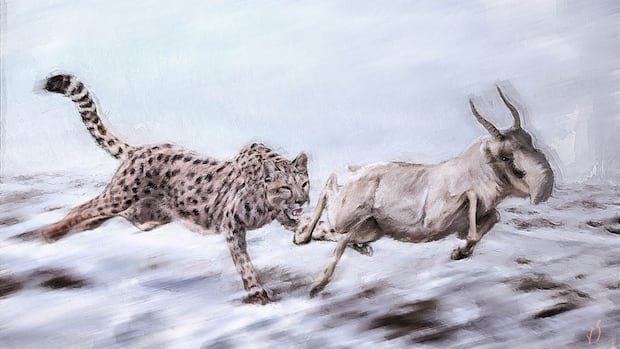

Initially, the bones discovered in the Bluefish Caves and a mine site in northern Yukon were thought to be from an ice-age puma or cougar. However, DNA testing from the University of California revealed a different story. The analysis, conducted by Molly Cassatt-Johnstone, a recent graduate working as a lab technician at the time, indicated that the Yukon bones did not belong to pumas but to cheetahs.
Grant Zazula, a Yukon paleontologist, vividly recalls his surprise upon receiving the message stating that the supposed cougars were, in fact, cheetahs. Zazula noted that twenty-five years ago, studying ancient DNA seemed like science fiction, but now it has become a routine practice for analyzing genetic material from permafrost-preserved bones in the Yukon.
Cassatt-Johnstone’s discovery of a Yukon Miracinonyx, the extinct American cheetah, marked a significant milestone. She is now the lead author of a paper published in Current Biology, providing new insights into the ice-age cat’s diet and habitat range.
‘A Fascinating Investigation’
Previously, researchers believed the American cheetah, resembling modern cheetahs in physique, evolved to hunt pronghorns in grassy plains. The unexpected presence of these cheetahs in the Arctic tundra puzzled paleontologists.
Cassatt-Johnstone explained that the cheetahs were initially thought to be specialized predators of American pronghorn antelope in the lower 48 states, where pronghorns were abundant. However, Beringia, the land connecting Asia and North America which includes present-day Russia’s easternmost region, Alaska, and the Yukon, had no pronghorns.
To unravel how Miracinonyx thrived in this environment, the study team, in collaboration with researchers from Canada and the U.S., employed stable isotope analysis. This technique, commonly used in forensics, examines chemical traces to determine the diet and environmental conditions of ancient organisms.
By analyzing bone fragments from the cheetah’s limbs, researchers like Matthew Wooller were able to deduce that the Yukon cheetahs primarily fed on fish. This dietary behavior, uncommon among cats past and present, was likely influenced by the ecosystem dynamics of the region.
Meachen, a paleontologist specializing in mammalian carnivores, emphasized the uniqueness of the Yukon cheetahs’ behavior compared to their counterparts in Wyoming. She suggested that the abundance of Yukon salmon could have made them an easy prey choice over competing predators like Beringian lions and giant bears.
The study’s genetic analysis revealed that Miracinonyx had a closer genetic relationship to North American pumas than African cheetahs. Additionally, the research indicated that the cheetah population had low genetic diversity, which could have contributed to their eventual extinction.
Zazula proposed renaming this distinct northern population from ‘American Cheetah’ to ‘Yukon Cheetah’ to reflect their specialized adaptation to the region’s unique environment.
Reflecting on the discovery, Zazula highlighted the ongoing potential for new revelations in paleontology, emphasizing that every bone found can unveil a previously unknown story.
Tag: rewrite-complete