
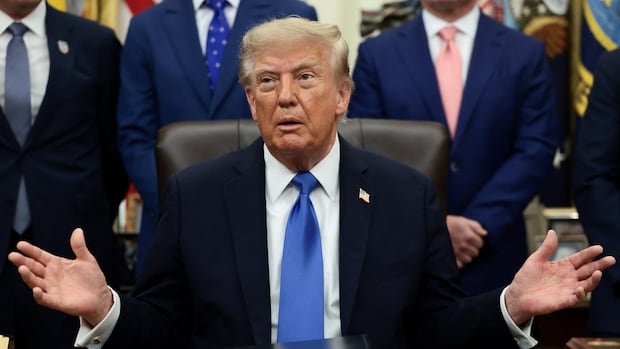

U.S. President Donald Trump suggested during a meeting with travel industry leaders that the Bank of Canada operates as a commercial bank in the United States, rather than being a government-owned entity solely based in Canada. Trump reiterated his belief that Canada exploits the U.S. economically, pointing out that American banks are not permitted to operate in Canada, while Canadian banks have a significant presence in the U.S.
Contrary to Trump’s assertions, the Bank of Canada is not a typical commercial bank serving the public for day-to-day financial transactions. It functions as a Crown corporation overseeing banking services on behalf of the Canadian government and does not have operations in the U.S. Additionally, the Bank of Canada is responsible for setting interest rates, having recently maintained its benchmark rate at 2.25% amidst warnings of rising inflation.
Despite Trump’s claims, U.S. financial institutions do have a presence in Canada under the Schedule 2 category, which includes foreign-owned banks with Canadian subsidiaries. Examples include JPMorganChase and Citibank, the latter having operated in Canada for over a century. However, American banks face stiff competition from Canada’s dominant banking sector, comprised of the “Big Six” banks: Royal Bank, Bank of Montreal, Scotiabank, CIBC, TD Bank, and National Bank. These major Canadian banks, falling under the Schedule 1 category, are required to be Canadian-owned and accept deposits, posing obstacles for any American bank seeking to acquire them.