
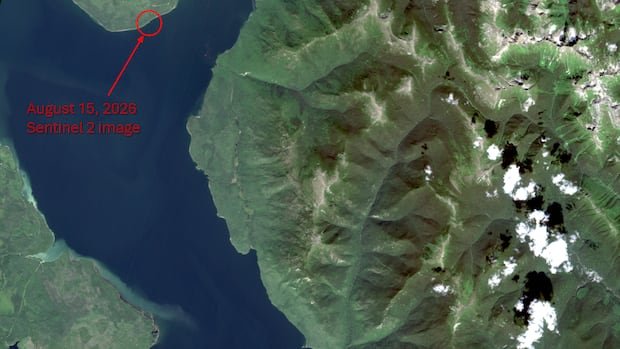

A new landmass has emerged in the largest lake in British Columbia. B.C. Hydro announced on Monday that this forested island, larger than a Canadian football field, had drifted approximately 30 kilometers northwest from its previous location in the center of Williston Reservoir.
The island’s unexpected appearance and subsequent disappearance within the vast man-made lake in northern B.C. have attracted global attention and fascination since boaters first spotted it in August. According to B.C. Hydro spokesperson Bob Gammer, satellite images from August 15 show the island situated at the north entrance of the Ospika Arm, where the Ospika River meets the reservoir.
Although the island’s origin remains unconfirmed, B.C. Hydro speculates that the record-high water levels likely caused it to detach from the reservoir’s extensive shoreline. Gammer explained that strong winds would have propelled the island across open waters over the past month.
The Williston Reservoir, established in 1968 and ranking as the seventh-largest globally, has a history of erosion along its banks, making them susceptible to landslides. The island, estimated to be around 70 meters wide and 140 meters long, equivalent to approximately 9,800 square meters, comprises floating wood mats with trees. John Clague, an earth sciences professor at Simon Fraser University, highlighted the uniqueness of this phenomenon and emphasized the need for further investigation to understand its formation.
B.C. Hydro is closely monitoring the island’s movements, considering the possibility of it drifting again due to strong winds. While the island’s presence has sparked interest among residents of northern B.C. and global onlookers, caution is advised for boaters as the island’s stability remains uncertain.