
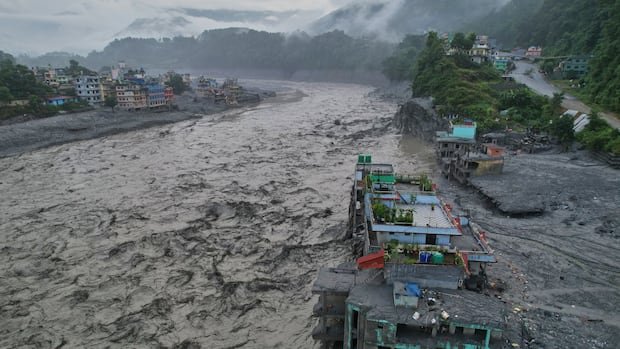

Authorities in Nepal have issued warnings of potential new flooding, advising residents in affected areas to stay vigilant following a rise in water levels in the Bhotekoshi River. Flood alerts were sent to people’s mobile devices early Sunday as rescue teams worked to clear a vital highway linking Kathmandu to a severely impacted zone hit by devastating floods last Wednesday, claiming the lives of at least 800 individuals and leaving over 3,000 missing in Nepal and Tibet.
In Dhading, one of the hardest-hit regions in Nepal, some locals have begun returning to their destroyed homes to assess salvageable items. Amid homes with washed-away walls, residents are clearing mud and debris from balconies and salvaging belongings. Despite the destruction, some residents found solace in rescuing their livestock, like one man who safely retrieved his chickens.
Sharmila Tamang, a resident of Dhading, expressed the devastation, stating, “Everything is finished. Nothing is left. Not even our home.” Meanwhile, workers at a critically damaged power plant initiated surveys on Sunday to evaluate the extent of the damage. This plant serves over 20,000 residents across four districts.
In Galchhi town, residents sought refuge on a nearby bridge while witnessing the powerful river flow. The aftermath of the floods revealed homes, vehicles, and farm equipment submerged in thick mud, with rice terraces collapsing into the river due to landslides.
Nepal’s disaster agency reported a death toll of 788 with 2,502 missing, while Chinese authorities confirmed 16 fatalities and 546 missing on the Chinese side of the border. The missing individuals include numerous foreign nationals who were in the region for work, tourism, or religious purposes.
Residents continue to receive frequent flood alerts, with electricity still unavailable in untouched areas due to damaged power infrastructure. The Prithivi Highway, crucial for supplying goods to Kathmandu, faces repair challenges despite partial operational status.
Residents in flood-affected villages struggle with ongoing alarms and evacuation orders, with some expressing difficulty in coping with the continuous threats. The destruction of bridges has isolated communities on either side of the river, compounding the challenges faced by residents.
Wednesday’s flash floods, triggered by a glacial collapse in the Himalayan region, resulted in catastrophic consequences. The cascading rocks and melted water inundated valleys, causing widespread devastation in Tibet and Nepal. Nepal’s foreign minister emphasized the urgent need for global action on climate change, highlighting the disproportionate impact felt by Nepal despite its minimal contribution to global emissions.
While scientists have refrained from directly linking global warming to the recent catastrophe, they warn that rising temperatures due to human activities heighten the risk of such disasters. The Himalayan region, experiencing accelerated warming, is particularly vulnerable to climate-induced calamities.
By addressing the aftermath of the recent floods and acknowledging the broader climate crisis, Nepal and its neighboring regions underscore the urgency of collaborative efforts to mitigate environmental risks and protect vulnerable communities.