
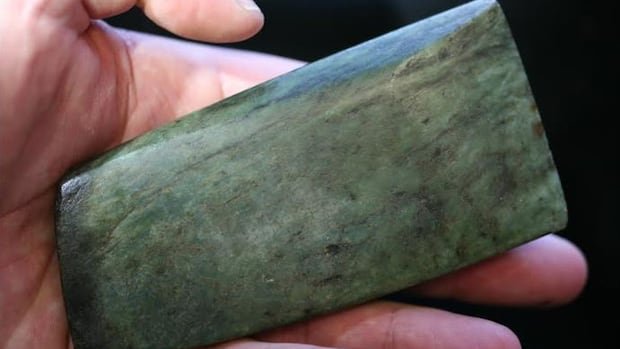

New findings from recent research on jade artifacts discovered east of the Rocky Mountains provide insights into extensive Indigenous trade networks in pre-colonial Western Canada. Over a span of more than 3,000 years, nephrite jade pieces were meticulously crafted into blades, chisels, and axe heads. These tools, made from a durable stone available in various colors like emerald green, black, yellow, and white, were crucial for central and coastal Salish communities in the Pacific Northwest for daily woodworking tasks.
Some of these stone tools originated from quarries in British Columbia and made their way across the Rocky Mountains to regions in Alberta, Saskatchewan, and Manitoba. A peer-reviewed study conducted by the Edmonton-based Archaeological Survey of Alberta, in collaboration with researchers from the University of Alberta, University of British Columbia, University of Saskatchewan, and Royal Saskatchewan Museum, delved into the significance of these tools known as stone celts, which were considered prestigious items in the Prairies.
The study revealed that these celts, crafted in present-day British Columbia, were traded to Dene and Cree communities east of the Rockies through well-established pre-contact trade networks that transcended cultural and linguistic boundaries. Todd Kristensen, regional archaeologist with the Archaeological Survey of Alberta and the lead author of the study, highlighted that the distribution of these artifacts indicates the formation of large social networks among Indigenous peoples in Western Canada.
The research aimed to address longstanding anthropological inquiries regarding the use of nephrite by pre-contact societies in British Columbia and its presence east of the Rockies. Through mineral composition analysis using portable X-ray fluorescence, gamma spectrometry, and specific gravity testing, researchers confirmed that the 24 recorded nephrite celts originated from the Fraser River region in British Columbia.
On average, these celts traveled nearly 850 kilometers from their source, with some covering almost 1,500 kilometers. The study proposed various potential trade routes through which these items traversed the continent, suggesting interactions between Interior Salish artisans and neighboring Dene groups, as well as trade exchanges between Salish and Dene communities.
Manufacturing a single nephrite celt required extensive labor for grinding and polishing, with smaller pieces taking over 100 hours to create, and larger ones up to 500 hours. The study noted that while celts in the Pacific Northwest were continuously used and maintained, those found in parklands and boreal forests were larger with minimal wear, indicating their transition from functional tools to symbolic objects of prestige as they traveled further.
Kristensen compared the significance of these stone celts to sentimental items displayed in modern times, emphasizing the value placed on them through the effort invested in their creation. The research sheds light on the interconnectedness and long-distance interactions among pre-contact Indigenous groups in Western Canada, challenging the notion of isolation and highlighting the importance of relationships in understanding past societies.
Kisha Supernant, director of the Institute of Prairie and Indigenous Archaeology at the University of Alberta, commended the researchers for engaging with Indigenous communities and incorporating traditional oral histories into their findings. Moving forward, the research team plans to further collaborate with Indigenous groups to enhance the study’s insights into pre-contact Indigenous cultures and trade networks.