
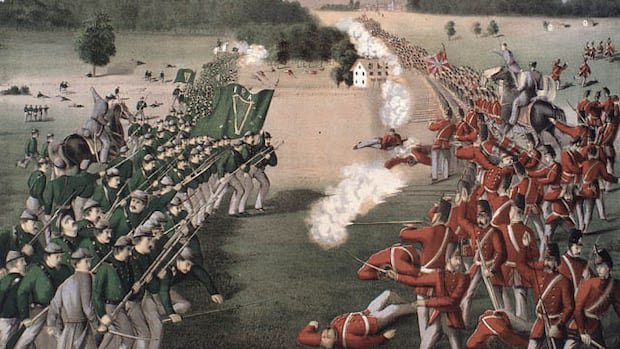

An unfamiliar clash occurred on Canadian territory a year before Confederation, resonating primarily in the historical memory of Fort Erie, Ont. The Battle of Ridgeway, also known as Limestone Ridge, in 1866 marked the first instance of Canadian troops led by Canadian officers engaging in combat. This battle also served as the inspiration for Decoration Day, a precursor to Remembrance Day celebrated in various regions of Canada annually. Despite these historical milestones, the nine casualties of the battle are notably absent from the Books of Remembrance, a collection on Parliament Hill honoring soldiers who perished in service to Canada.
A new petition scheduled for presentation in the House of Commons aims to include the names of the nine fallen soldiers and the numerous others who died following the battle in the aforementioned list. Conservative MP Fred Davies, the advocate behind this initiative, emphasized the importance of Canada acknowledging those who sacrificed their lives in defense of the nation. Davies, who represents the Niagara South riding encompassing Fort Erie, expressed his personal connection to the battleground, underscoring the need for national recognition of the events that transpired there.
The Battle of Ridgeway did not culminate in a decisive Canadian triumph. Inexperienced volunteers confronted Fenian raiders, many of whom were veterans of the American Civil War. The Fenian Brotherhood, an Irish American movement, sought Irish independence from British rule by invading and occupying parts of British North America to leverage for Irish autonomy negotiations. In 1866, hundreds of raiders crossed the Niagara River with intentions to target the Welland Canal, encountering approximately 800 Canadian volunteers from various regiments at Limestone Ridge near Ridgeway and Fort Erie.
Historian Peter Vronsky, author of “Ridgeway: The American Fenian Invasion And The 1866 Battle That Made Canada,” commended the swift mobilization of hundreds of Canadians from the Golden Horseshoe region. However, he highlighted the ill-preparedness of Canadian troops for what he deemed Canada’s inaugural modern battle, lacking food rations, water, appropriate footwear, and ammunition. Despite engaging in combat with the invaders and a subsequent chaotic retreat following a Fenian bayonet charge, the Canadians managed to repel the incursion as the Fenians retreated back to the U.S. side of the Niagara River.
Although the Battle of Ridgeway resulted in a battlefield defeat, Davies emphasized that the sacrifice of the fallen soldiers remains significant. He stressed that despite organizational weaknesses and inadequate preparations, the individuals fought valiantly to protect Canada from invasion, warranting recognition and honor for their bravery.
A memorial commemorating the nine fallen soldiers of Ridgeway was erected in 2016 on the battle’s 150th anniversary. Despite longstanding efforts by Fort Erie to have their names included in the Books of Remembrance, these attempts have been unsuccessful thus far. Mayor Wayne Redekop asserted the importance of acknowledging the pivotal role these soldiers played in shaping Canada’s history.
While the battle predates the official formation of Canada, the Books of Remembrance feature soldiers who died before Confederation, including those from the War of 1812. Redekop, Davies, and Vronsky contended that the Battle of Ridgeway had a direct impact on the path to Confederation, influencing individuals to support the concept. Vronsky noted that the battle served as a defining moment for Canada, both symbolically and sentimentally.
Several regiments that participated in the 1866 battle, such as the Queen’s Own Rifles and the Royal Hamilton Light Infantry, continue to exist today, representing the evolution and endurance of Canada’s armed forces. The Battle of Ridgeway holds historical significance, with figures like Alexander Muir, who wrote “The Maple Leaf Forever” after fighting in the battle, encapsulating the patriotic fervor that emerged from the conflict. Vronsky suggested that Canadians were now fighting for their local communities and identity, with the maple leaf symbolizing a newfound sense of national allegiance and pride.