

After Iranian Shahed drones attacked the Mina Al-Ahamadi oil refinery in Kuwait, Ukrainian President Volodymyr Zelenskyy announced that Kyiv has dispatched over 200 military experts to the Middle East to aid in safeguarding critical infrastructure from similar threats that Ukraine has been confronting for years.
Zelenskyy disclosed that 228 Ukrainian drone specialists have been deployed to five countries, including Qatar, the United Arab Emirates, Saudi Arabia, Kuwait, and Jordan. Following the commencement of airstrikes by the U.S. and Israel against Iran on February 28, Gulf Arab states have been under attack from over 2,000 drones and missiles.
These nations, which have endured assaults on energy infrastructure, hotels, and diplomatic premises, are expressing strong interest in procuring Ukraine’s interceptor drones in large numbers. Kyiv has indicated that substantial agreements and transactions are in progress.
Andrii Sych, co-founder of the Kyiv-based UV military cluster, a manufacturer collaborating with other drone firms, stated, “In the past week, we have received four different requests for interceptors from the Middle East,” highlighting the significant demand for such equipment.
While one of the inquiries originated from the United Arab Emirates, no interceptors have been officially sold by the manufacturer yet due to the requirement of an export license from Kyiv and authorization to vend defense technology overseas.
Ukraine possesses unparalleled expertise in neutralizing Iranian drones, which were initially utilized by Russia in late 2022. Since then, manufacturers countrywide have been at the forefront of developing drone interceptors, driven by the necessity to counter daily lethal attacks and extensively tested technology in combat scenarios.
Sych, a former mobile app testing engineer who shifted focus to drone development after the war broke out, highlighted the company’s transition to concentrating on larger, winged drones resembling the Shahed model. This shift was prompted by what he described as “a crisis in air defense solutions” faced by Ukraine.
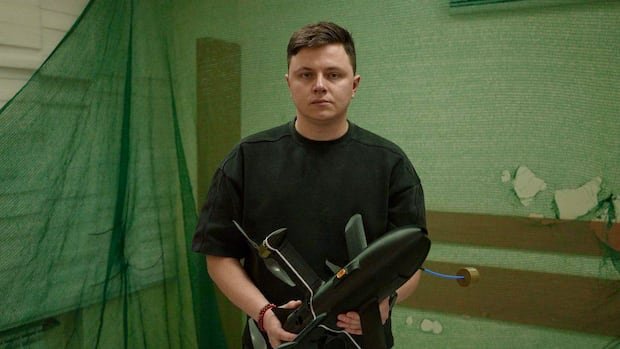
At a confidential location in the Kyiv region, where a worn Russian flag serves as a doormat, Sych and Danylo Kholiavko, the founder of UV military cluster, demonstrated the functionality of one of the manufacturer’s interceptor models. The drone’s body frame, made using a 3D printer, features a design akin to a “bullet with wings,” inspired by racing drones used by Red Bull.
Kholiavko showcased a model capable of exceeding 300 kilometers per hour, equipped with a thermal camera to detect Shahed drones commonly launched during nighttime operations. The interceptor, armed with explosives, can be detonated remotely or upon collision with the targeted drone.
The cost of the interceptor itself varies depending on the model, approximately around $2,000 US, with additional expenses for the ground station containing radar equipment and the personnel managing it. Kholiavko emphasized the complexity of intercepting Shahed drones, highlighting the initial challenges that were eventually overcome through tactical adjustments and ground crew coordination.
Sych explained that interceptor drones operate in three primary modes, including manual control by a ground pilot using visual feedback, autonomous tracking and striking post-launch, and fully autonomous identification and launch. He stressed the critical role of trained personnel in the interception process, underscoring the significance of effective training over advanced UAV technology.
UV military cluster claims a production capacity of approximately 7,000 interceptors per month. Zelenskyy, during a meeting in London with U.K. Prime Minister Keir Starmer, mentioned that with all Ukrainian drone manufacturers combined, the country can produce up to 2,000 interceptors daily. While Ukraine reserves half for its defense needs, the surplus interceptors can be sold provided supporting countries agree to assist Ukraine.
Kyiv has ongoing collaborative drone production ventures with Germany, Britain, Denmark, the Netherlands, and will soon commence a partnership with Norway.