
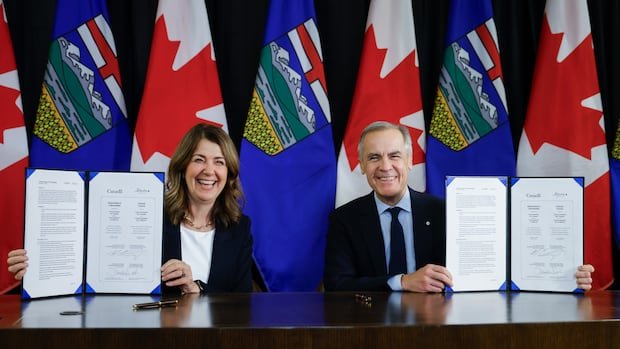

The federal and Alberta governments are finalizing an agreement on industrial carbon pricing, a critical policy aimed at reducing harmful greenhouse gas emissions in Canada.
Confirmed by CBC News, both levels of government have reached an understanding that Alberta’s effective carbon price will rise to $130 per tonne by 2040. The Calgary Herald also reported on this development, with an official announcement expected before the week’s end, according to sources familiar with the matter.
Under Canada’s national carbon pricing system, all provinces and territories are mandated to adhere to a set price. The headline price was slated to increase to $170 per tonne by 2030. Presently, the headline price in Alberta stands at $95, although polluters have the option to buy carbon credits on the market to offset their obligations, resulting in an effective price of around $45 per tonne in the province.
The Alberta system governing heavy emitters, known as Technology Innovation and Emissions Reduction Regulation (TIER), was designed to escalate the carbon price to a minimum effective credit price of $130 per tonne as per the energy accord inked by both governments in November.
Industry stakeholders stress that establishing clear pricing mechanisms is crucial for instilling confidence in energy investments and is pivotal for initiatives like the Pathways Plus carbon capture, utilization, and storage project.
While there are a few outstanding issues to be resolved, an announcement is anticipated soon, with Prime Minister scheduled to travel to Alberta to unveil the agreement alongside Premier Danielle Smith. Additionally, former Alberta Finance Minister Doug Horner hailed the agreement as a significant achievement that showcases Canada’s collaborative spirit and benefits the entire nation.
The agreement comes amid discussions about a possible referendum on separatism in Alberta, with proponents of staying within the federation finding optimism in the negotiation breakthrough. However, the prospect of Alberta receiving a “special” federal carbon price has raised concerns in British Columbia, with Premier David Eby highlighting potential challenges in maintaining competitiveness if Alberta secures a unique pricing advantage.
Ensuring robust industrial carbon pricing is seen as vital for Alberta and Canada’s goal of achieving net-zero emissions by 2050. The trading system allows emitters to earn credits for reducing emissions, though an oversupply of credits in Alberta has led to lower trading prices than the headline rate.
With the agreement to raise the credits to $130 per tonne, questions linger on whether emissions reductions will align with climate targets. Modeling by the Canadian Climate Institute suggests that the timelines outlined may not be sufficient to meet the desired carbon price goals.
Negotiations surrounding the timeline for carbon pricing have been a point of contention, with Alberta seeking to cap the $130 per tonne figure until 2050, while Ottawa aimed for it to be the starting point for further increases by 2030 or 2035. A compromise appears to have been reached, paving the way for both governments to address other aspects of the memorandum of understanding, including an oil pipeline to the Pacific coast, the Pathways project, AI computing expansion, and the development of transmission lines with neighboring provinces.