
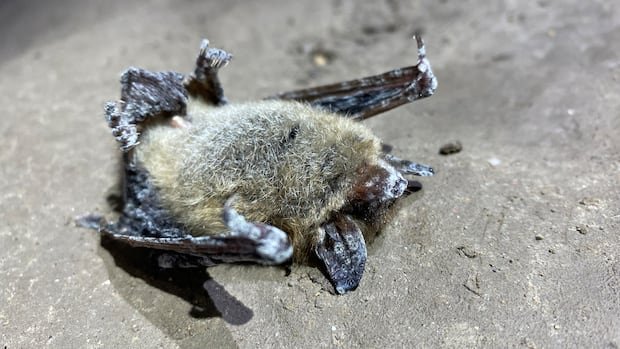

A lethal fungus that has devastated bat populations throughout North America is spreading in Alberta. White-nose syndrome has been identified in the Rocky Mountains of Alberta for the first time, indicating a significant expansion of the disease since its initial confirmation in the province in 2024. Over 6.7 million bats have succumbed to the disease in North America since 2006, according to the Center for Biological Diversity.
This disease is caused by a fungus that infects bats’ skin during hibernation, leading them to awaken prematurely and face starvation, dehydration, and eventual death. The fungus responsible for white-nose syndrome was first detected in Alberta in 2022, with the confirmation of the disease’s symptoms coming two years later.
Recent surveys conducted by the provincial government and Wildlife Conservation Society Canada revealed white-nose syndrome in three caves in the Rockies, including Cadomin and Wapiabi in central Alberta, both closed to the public since 2010 to prevent the spread of the disease among hibernating bats.
Experts express concern over the declining bat populations, with an estimated 80% decrease in a recent habitat survey. The little brown bat and northern myotis, both endangered species according to the federal government, are among the six hibernating bat species in Alberta vulnerable to white-nose syndrome.
Efforts to combat the disease include the application of a probiotic treatment on bat houses during the summer, showing promising results in reducing fungus levels on bats and fostering bat-to-bat probiotic transmission. The province plans to continue these applications while monitoring bat health.
With white-nose syndrome affecting bat populations in every Canadian province except British Columbia, and in at least 40 U.S. states, conservationists stress the importance of public involvement in bat conservation efforts. Reporting bat roosts and submitting bat guano for testing are ways the public can contribute to monitoring and protecting bat populations. The ultimate goal is to raise awareness and appreciation for bats to ensure their survival in the face of this devastating disease.