
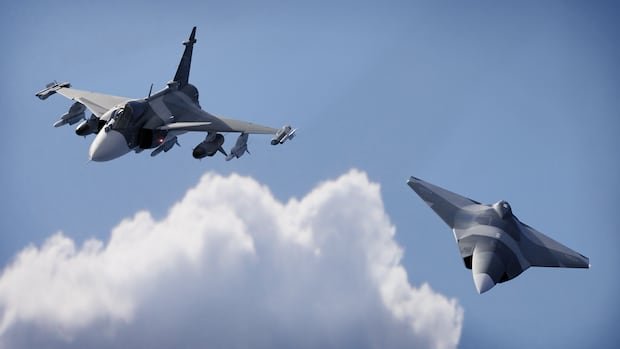

Saab, a Swedish company, is seeking collaboration with the Canadian government and local businesses to develop advanced systems for future aerial combat. The company aims to manufacture Gripen fighters and GlobalEye surveillance planes in Canada if the Canadian Armed Forces opt to acquire them. Saab and Sweden envision this partnership leading to joint efforts in designing upcoming military technologies.
Peter Nilsson, head of future programs at Saab, expressed the company’s interest in working with countries and firms possessing the necessary skills. Canada is seen as a favorable partner for such endeavors. Currently, Canada has an order in place for 88 American F-35s, with plans to potentially add Gripen fighters to diversify its aircraft fleet.
Discussions have commenced between Sweden and Canada regarding potential collaborations on research and development projects, although no decision has been finalized by the government. The Department of National Defence has confirmed its exploration of future options beyond the existing fighter jets.
Several nations are involved in projects to develop next-generation fighter jets, anticipated to integrate advanced technologies like artificial intelligence and stealth enhancements. Notably, Canada is considering participation in the Global Combat Air Program (GCAP) alongside preferences for F-35s.
Saab secured a significant contract from the Swedish armed forces in 2024 for the development of future fighter concepts. The company aims to leverage the expertise of major Canadian firms like Bombardier and CAE, as well as smaller aerospace and AI companies, in this project. Saab looks to tap into the innovative capabilities of civilian sector firms.
Saab is committed to generating around 10,000 job opportunities in Canada if it proceeds with the production of Gripen and GlobalEye aircraft for the Canadian Armed Forces. Senior executives from Saab have engaged in high-level meetings with Canadian defense officials and government representatives to discuss potential collaborations and opportunities for future partnerships.