
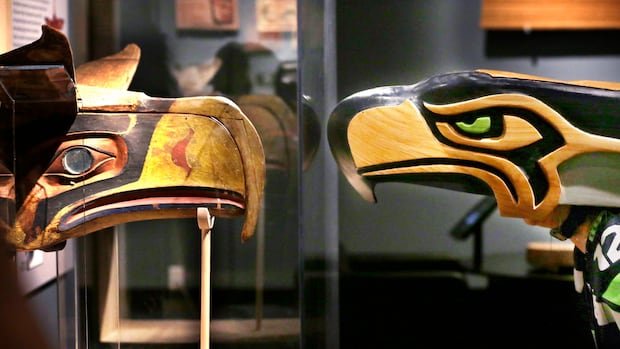

More than ten years ago, during the period when the Seattle Seahawks were about to make their first appearance in two consecutive Super Bowls, Robin K. Wright’s art history students at the University of Washington developed an interest in the NFL team’s emblem. Wright, now an emeritus professor at the university’s school of art, art history, and design, recalled her students’ entertaining theories, such as associating the logo with the Egyptian god Horus.
According to Wright, the inspiration behind the team’s logo, featuring a raptor profile, stems from a transformation mask originating from the Kwakwakaʼwakw community of northern Vancouver Island. She mentioned that her colleague Bill Holm, a curator emeritus of Northwest Coast art at the University of Washington’s Burke Museum, once pointed out the striking resemblance between the logo and a mask depicted in the 1950 book “Art of the Northwest Coast Indians” by Robert Bruce Inverarity.
Wright highlighted that despite Seattle being situated on Coast Salish territory, the mask in question belongs to the Kwakwakaʼwakw community’s territory, a fact that might have been overlooked by the logo designers. She suggested that if more research had been conducted and a local Indigenous design from the Seattle area had been sought, the designers might have opted for a Coast Salish motif. Nonetheless, the northern Northwest Coast art style was more prevalent in the public eye at the time.
The Seahawks logo, which has undergone several redesigns and refinements since its introduction in 1975, remains a recognizable symbol among football enthusiasts worldwide.
Days before the Seahawks clinched their first and only Super Bowl victory in 2014, Wright wrote a blog post discussing the potential link between the team’s logo and the Kwakwaka’wakw mask. Initially unaware of its whereabouts and speculating that it might be with a private collector, Wright later received confirmation from officials at the Hudson Museum at the University of Maine that the mask was part of their collection.
Transformation masks, such as the one in question, depict two forms: one while closed, and another when open. In this instance, the closed mask portrays a raptor, unfolding to reveal a human face, as described by Wright. However, the resemblance to the Seahawks logo was not immediately apparent due to how the mask was exhibited.
The Hudson Museum later facilitated the transfer of the mask to the Burke Museum in Seattle for public display. ‘Namgis First Nation artist Bruce Alfred, alongside museum officials donning gloves, inspected the mask during a visit to Washington state, confirming its Kwakwaka’wakw origin.
Alfred, aged 75, affirmed the mask’s Kwakwaka’wakw roots, indicating that its distinct style would be recognizable to local artists. While uncertain of the mask’s exact age, he estimated its creation date to possibly be in the 1860s or 1870s.
The article continues to discuss indigenous artists’ reinterpretation of the Seahawks logo, the controversy surrounding its initial design, and the historical context of European surrealists’ fascination with masks from the Northwest coast of North America. It also touches upon ongoing efforts for cultural repatriation and the cultural significance of transformation masks.
In conclusion, the narrative emphasizes the importance of introducing the rich history of Northwest Coast art to a broader audience, leveraging the unexpected association of the Seahawks logo with Indigenous cultural heritage as an educational opportunity.