

A school administrator in an Ontario community that tested seatbelts on three school buses mentioned encountering some challenges, especially with younger students. However, they also noted an improved sense of student safety and unexpected benefits.
Renée Boucher, executive director at the Sudbury Student Services Consortium, shared that the three bus drivers involved in the experiment expressed their preference for buses equipped with seatbelts. She highlighted the positive impact observed during and after the pilot project.
In light of a recent rural accident in Manitoba that injured multiple students, discussions on school bus safety have intensified. Two Ontario and two British Columbia communities that implemented seatbelts on school buses in recent years may provide valuable insights for Manitoba.
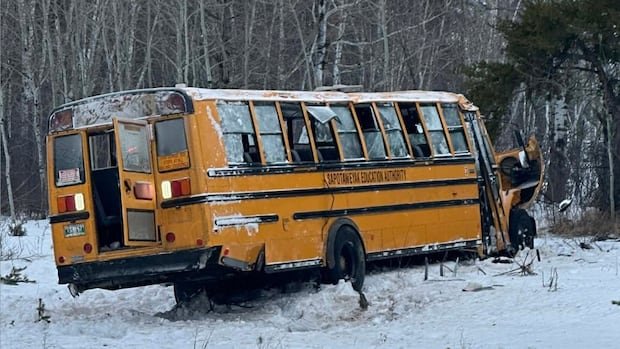
Following a rollover incident involving a bus carrying 14 high-school students from Sapotaweyak Cree Nation, discussions on enhancing safety measures, including seatbelts, have gained momentum. While some students were airlifted to Winnipeg for treatment, others were taken to a nearby hospital in Swan River.
The investigation into the crash is ongoing, and as of now, no charges have been laid. Manitoba’s premier expressed openness to discussing the implementation of seatbelts on school buses but emphasized the need to consider all aspects of the recent accident.
The article also delves into the historical context of school bus safety design, highlighting the concept of “compartmentalization” as a longstanding approach to protecting students during transportation. While earlier research favored this system over seatbelts, recent developments have questioned its effectiveness in certain collision scenarios.
The Sudbury Student Services Consortium participated in a seatbelt pilot program as part of a wider study on enhancing school bus safety in Canada. The initiative, which involved collaboration with other regions and government bodies, aimed to evaluate the feasibility and impact of seatbelt usage on school buses.
Despite some initial challenges, such as reduced bus capacity and additional time required for seatbelt usage, the pilot programs showed promising results. The introduction of seatbelts not only enhanced student safety but also positively influenced student behavior and driver focus.
Overall, the experiences shared by various communities underscore the potential benefits of incorporating seatbelts on school buses and suggest valuable insights for improving student safety across different regions.