
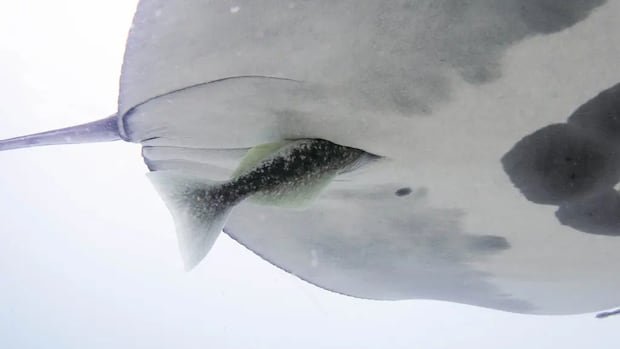

Suckerfish have been discovered to exhibit less-than-considerate behavior as they hitch rides on larger marine animals like sharks, whales, and manta rays, feeding on parasites in exchange for transportation. However, recent research led by marine researcher Emily Yeager from the University of Miami suggests that this symbiotic relationship may have drawbacks for manta rays.
In a study published in the journal Ecology and Evolution, Yeager and her team detailed a phenomenon termed “cloacal diving,” where suckerfish dive into the cloaca of their hosts, a multipurpose orifice for reproduction and waste elimination. While cloacal diving had been observed between remoras and whale sharks before, this study marks the first documented evidence of such behavior between remoras and manta rays.
The researchers documented seven instances of cloacal diving across various oceanic locations over a 15-year period, suspecting that it occurs more frequently than observed. Yeager explained that the remoras may engage in this behavior as a fear response, as seen in a video where a remora startles and dives into a manta ray’s cloaca, causing the ray to shudder before continuing its journey.
Brooke Flammang, a biological sciences professor at the New Jersey Institute of Technology who has studied remoras, suggested that the behavior might be linked to coprophagy, or consuming feces, as a potential source of food for the suckerfish. While the exact motivation behind this behavior remains uncertain, Flammang emphasized that remoras’ territorial nature could drive such actions.
Regarding the impact on manta rays, Yeager expressed concerns about potential skin damage and reproductive issues caused by remoras entering the cloaca, potentially disrupting the symbiotic relationship between the two species. She highlighted that nature’s relationships are not always easily categorized as strictly symbiotic or commensal, suggesting a more nuanced spectrum of interactions.
The implications of cloacal diving on manta rays raise questions about the dynamics of interspecies relationships in marine ecosystems, emphasizing the complexity of symbiotic interactions beyond conventional classifications.