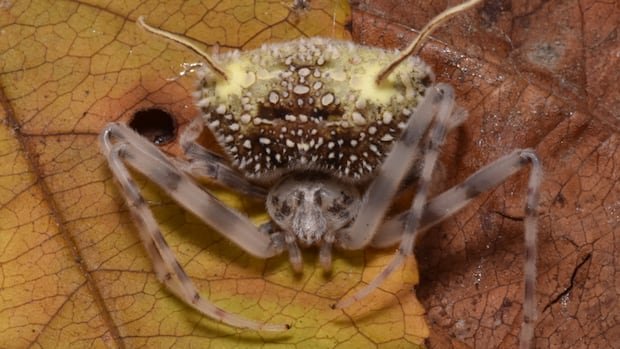

In a surprising encounter during an August 2025 group tour, scientist Alexander Bentley discovered a spider seemingly alive under what appeared to be a lethal parasitic fungus. As an expert herpetologist in Ecuador, Bentley encountered cordyceps, a parasitic fungus known for its control over insects and arachnids, resembling the fictional “zombie fungus” in the post-apocalyptic series “The Last of Us.”
The spider exhibited tubercles on its abdomen, typical of cordyceps-infected hosts, leading Bentley to believe it was a victim surviving the infection process. However, further investigation revealed it to be a novel arachnid species mimicking fungus like cordyceps, possibly for hunting or defense purposes, as detailed in the publication by Zootaxa.
Collaborating with David Ricardo Díaz-Guevara, a fellow researcher, Bentley confirmed the spider’s uniqueness as a new species named Taczanowskia waska. The identification process involved meticulous morphological analysis against existing spider species within the genus.
The spider’s uncanny resemblance to cordyceps raised questions about its evolutionary adaptation. Some speculate it could aid in hunting by camouflaging the spider or serve as a defense mechanism against predators. However, the exact purpose of the spider’s fungal mimicry remains uncertain pending further research.
This groundbreaking discovery, facilitated by citizen science platforms like iNaturalist, showcases the value of public engagement in scientific endeavors. The finding has intrigued experts like Mycologist Monika Fischer, emphasizing the importance of such collaborative efforts in advancing knowledge of biodiversity.
While the spider’s mimicry of cordyceps poses intriguing evolutionary questions, researchers like Bentley and Díaz-Guevara are excited about this unprecedented find in the Amazon rainforest, highlighting the uniqueness and significance of their discovery.