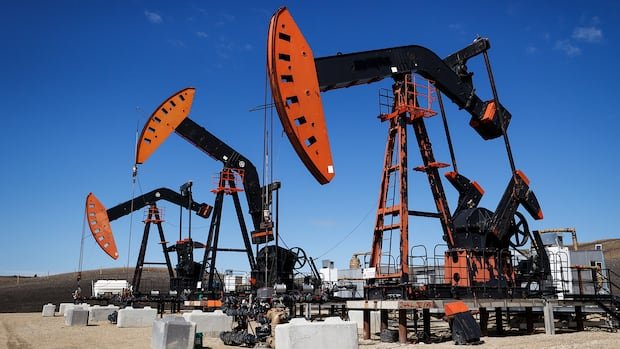

Oil prices experienced a decline on Monday morning following President Donald Trump’s announcement that the United States would delay any strikes on Iran’s energy facilities due to positive discussions between the two nations. The price of a barrel of West Texas Intermediate, the key North American benchmark, fell by over nine percent to below $90 US, while stock markets saw a surge at the opening of trading.
By the market close, the S&P 500 had increased by 74.52 points to 6,581.00, the Dow rose by 631.00 points (1.4 percent) to 46,208.47, and the Nasdaq composite climbed by 299.15 points (1.4 percent) to 21,946.76. Additionally, the S&P/TSX composite index went up by 566.40 points, reaching 31,883.81.
Trump deferred the strikes on Iranian power facilities for five days, citing productive discussions aimed at resolving hostilities in the Middle East. The conflict in the Middle East has caused oil prices to surge by approximately 50 percent this month.
In contrast to his earlier statements over the weekend threatening escalation, Trump’s recent remarks signaled a shift towards diplomacy. He had warned on Truth Social that failing to open the Strait of Hormuz without coercion within 48 hours would prompt the U.S. military to target Iranian power plants.
The Islamic Revolutionary Guard Corps responded by declaring intentions to fully close the Strait of Hormuz in retaliation against any U.S. actions targeting Iranian energy infrastructure. Trump has outlined military objectives for the conflict with Iran, emphasizing the degradation or destruction of Iran’s military, defense infrastructure, and nuclear weapons program, in addition to safeguarding American allies in the region.
Energy prices have surged over the past three weeks due to Iran’s restrictions on access to the Strait of Hormuz, a critical passage through which 20 percent of global oil exports, as well as natural gas and other products, flow. Analysts from energy consulting firm Wood Mackenzie have suggested that oil prices could reach $200 a barrel in 2026 if disruptions in Gulf exports persist.
Even after the conflict resolves, a period of months may be necessary for energy markets to stabilize. Kurt Barrow, an oil, fuels, and chemicals analyst at S&P Global, highlighted the challenges in re-equalizing the system post-conflict.
The energy crisis has transitioned towards a demand and availability crisis, with a shortfall of approximately 15 million barrels per day not only in crude oil but also in jet fuel, diesel, and gasoline. The North American oil industry is grappling with significant uncertainty, with concerns that excessively high prices could dampen demand, particularly in the face of a global economic downturn.
Kevin Krausert, CEO of Avatar Innovations and former Alberta drilling executive, emphasized the seriousness of the current situation for the global energy industry. Despite the prevailing challenges, Krausert cautioned that prolonged high oil prices could introduce a new set of difficulties for the industry.
As Trump’s social media post coincides with the fourth week of the conflict with Iran, the oil sector remains cautiously observant of unfolding developments.