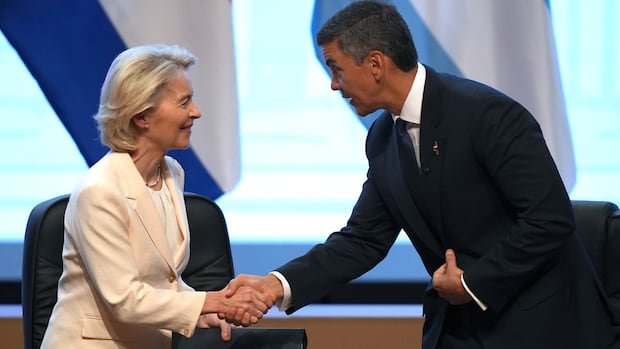

The European Union and the Mercosur bloc of South American countries have officially signed a significant free trade agreement after more than 25 years of challenging negotiations to enhance commercial relationships amid global trade tensions. The signing ceremony in Asunción, Paraguay symbolizes a crucial strategic win for the EU at a time of trade disputes with the U.S. and increased Chinese exports, strengthening the EU’s presence in a region abundant in resources which is being contested by major powers like the U.S. and China.
The agreement signifies the commitment of South America to maintaining diverse trade and diplomatic ties, countering U.S. President Donald Trump’s assertions of dominance in the Western Hemisphere. European Commission President Ursula von der Leyen emphasized the geopolitical importance of the deal, highlighting the EU’s preference for fair trade over tariffs and a sustainable partnership over isolation. The ceremony was attended by the leaders of Mercosur countries Argentina, Uruguay, and Paraguay, along with Brazil’s foreign minister.
The accord, which eliminates more than 90% of tariffs, establishes one of the largest free trade regions globally, uniting South America’s livestock-producing nations and Europe’s industrial sectors seeking new markets for automotive and machinery products. With a consumer base exceeding 700 million people and contributing a quarter of the world’s GDP, the agreement holds significant economic potential.
While the deal faces one final obstacle – approval by the European Parliament – concerns from protectionist groups on both sides, especially European farmers apprehensive about competition from cheaper South American imports, could impede its progress. Despite the reduction of tariffs on most goods and services between the two regions, gradual tariff reductions over a decade or more and restrictions on key agricultural products are in place to address European farmers’ worries.
The establishment of quotas, safeguard mechanisms, and substantial subsidies from the EU to support struggling farmers played a role in securing Italy’s backing for the agreement. However, France remains a notable opponent to the deal.